What a 400-Year-Old Philosopher Can Teach Us About Not Getting Fooled by AI
A few months ago, a client forwarded me an article about their industry. “Great research piece,” they said. “We should link to it from our blog.”
I read it. It was clean, well-structured, cited three academic studies, and made a compelling argument. It also felt… off. Not wrong, exactly. Just too smooth. Every paragraph the same length. Every transition perfectly weighted. No rough edges anywhere.
So I checked the citations. Two of the three studies didn’t exist. The article had been generated by AI. Not by a person who used AI as a writing tool. There was no person behind it. The whole thing was machine-produced, published on a content farm, and indexed by Google as if it were legitimate research.
My client, an intelligent, experienced professional, had read it and believed every word. I don’t blame them. I almost did too.
The moment we’re all living through
Something has shifted in the past two years, and most people haven’t fully registered it yet.
We used to live in a world where seeing was believing. A photograph was evidence. A published article carried weight. A voice on the phone belonged to a person. These weren’t naive assumptions. They were reasonable ones, built on centuries of how information worked.
That infrastructure is cracking.
AI can now generate a photograph of an event that never happened, and it will look indistinguishable from a real one. It can produce a video of a public figure saying words they never spoke. It can write a 3,000-word analysis of a topic, complete with citations, statistics, and expert-sounding conclusions, and get the core facts wrong while sounding absolutely certain.
The technology isn’t malicious. It’s doing exactly what it was designed to do: predict what a plausible answer looks like based on patterns in data. The problem is that “plausible” and “true” are not the same thing.
And we haven’t updated our instincts to account for that gap.
Enter a philosopher who saw this coming
René Descartes never heard of ChatGPT. He lived in the 1600s, wore a ruff collar, and spent his winters in a stove-heated room in Germany, thinking about whether reality was real.
But the question he was wrestling with is the same one we’re all facing now: how do you know that what you’re perceiving is actually true?
Descartes noticed something that bothered him. Our senses lie to us all the time. A stick looks bent in water. A tower looks round from far away but square up close. Dreams feel real while we’re in them. If our own perception can be fooled, how much of what we believe is built on solid ground?
So he ran an experiment. Not in a lab, but in his own mind. He decided to systematically doubt everything he could possibly doubt. The physical world. His own body. The existence of other people. He pushed doubt as far as it could go until he hit a wall: He couldn’t doubt that he was doubting. The very act of questioning proved that there was a mind doing the questioning. Even if everything else were an illusion, even if some cosmic deceiver were manipulating his entire experience, the doubter had to exist.
That’s where “I think, therefore I am” comes from. Not as a celebration of thinking, but as the one thing left standing after everything else had been stripped away.
For four hundred years, this was treated as an interesting philosophical exercise. A thought experiment for university seminars.
It isn’t anymore.
Why this matters right now
Here’s the thing about AI-generated content that makes it different from ordinary misinformation.
When a person lies, they usually know they’re lying. There’s intent. You can trace it. You can hold someone accountable.
When AI produces something false, there’s no intent at all, at least not yet. The machine doesn’t know the difference between a real study and a fabricated one. It doesn’t experience certainty or doubt. It just generates the next most likely word in a sequence, and the result happens to look authoritative.
This is what the AI field calls “hallucination,” a term that’s almost too gentle for what it describes. The machine isn’t seeing things. It’s constructing plausible fictions with the confidence of an expert witness.
And confidence is the key word. We’re wired to trust information that sounds certain. When something is well-structured, clearly written, and stated without hedging, our brains default to “this person knows what they’re talking about.” That heuristic served us well when there was always a person behind the information. Now there often isn’t.
The old systems are breaking down
Think about how trust in information used to work. A newspaper had editors who checked facts before publication. An academic journal had peer reviewers. A book had a publisher whose reputation was on the line. Even a blog post had an author with a name and a track record.
These systems weren’t perfect, but they created a chain of accountability. If something was wrong, you could trace it back to a human decision.
Today, a piece of content can be generated by a machine, posted to a website with no editorial oversight, optimized for search engines, shared across social media, and read by tens of thousands of people, all before a single human being has evaluated whether it’s true.
We’re not in an information vacuum. We’re drowning in information. The scarce resource isn’t content. It’s judgment. And judgment is the one thing AI cannot provide.
Doubt as a skill, not a weakness
When people hear “doubt,” they think negativity. Cynicism. Distrust. Descartes meant something completely different. His doubt wasn’t about rejecting everything. It was about finding what couldn’t be rejected. It was constructive. He doubted in order to build on firmer ground. That’s the kind of doubt we need now.
Not paranoid suspicion of everything we read. Not a retreat into “nothing is real anymore.” But a quiet, habitual practice of pausing before we accept something just because it looks convincing.
Did I verify the source? Is there a real person behind this claim? Can I find the same information somewhere else, independently?
These aren’t philosophical abstractions. They’re practical reflexes. And they’re becoming as essential as knowing how to read.
What machines can do, and what they can’t
We work with AI every day. We use it at Olibro to accelerate research, generate first drafts, analyze data, and prototype ideas. It’s a remarkable tool, and I’d be dishonest if I pretended otherwise. But there’s a clear line between using AI as a tool and mistaking its output for truth.
A machine can produce text. It cannot take responsibility for that text. A machine can cite a source. It cannot verify that the source exists. A machine can sound confident. It cannot be confident, because confidence requires understanding, and understanding requires consciousness.
The thing that Descartes discovered in that stove-heated room, the irreducible fact of a mind that knows it’s thinking, is exactly the thing AI doesn’t have. And it’s exactly the thing that makes human judgment irreplaceable.
A new motto for a strange era
Descartes gave us “I think, therefore I am.” It was a statement about existence. But in 2026, thinking alone isn’t the differentiator it used to be. Machines can produce something that looks like thinking. They can mimic reasoning, summarize arguments, and generate conclusions that would pass a casual inspection. What they cannot do is doubt.
Doubt requires self-awareness. It requires the ability to step back from your own output and ask, “Is this actually right?” It requires the willingness to be uncertain, to sit with not-knowing, rather than generating an answer just because one is expected. That’s a uniquely human capacity. And it might be the most important one we have.
I doubt, therefore I am human.
Not because doubt is pleasant. Not because uncertainty is comfortable. But because the willingness to question, to resist the seductive pull of confident-sounding information, is the last line of defense in a world where machines can produce everything except wisdom.
What this means for the rest of us
I’m not suggesting we all become philosophers. I’m suggesting something simpler. The next time you read something that sounds perfectly polished, ask where it came from. The next time you see a photograph that triggers an emotional reaction, consider whether it’s real. The next time someone sends you a “great article,” check a citation before you share it.
These are small acts. But they add up to something significant. They add up to a culture that still values truth over plausibility. In a world increasingly filled with artificial intelligence, the most human act might not be creating. It might not be imagining. It might not even be thinking. It might simply be pausing and asking: do I actually believe this, or does it just look like something I should believe?
That pause is yours. A machine will never take it
Note: This article was developed with the assistance of AI tools for drafting and editing. All ideas, editorial decisions, and final content reflect the author’s views and judgment.
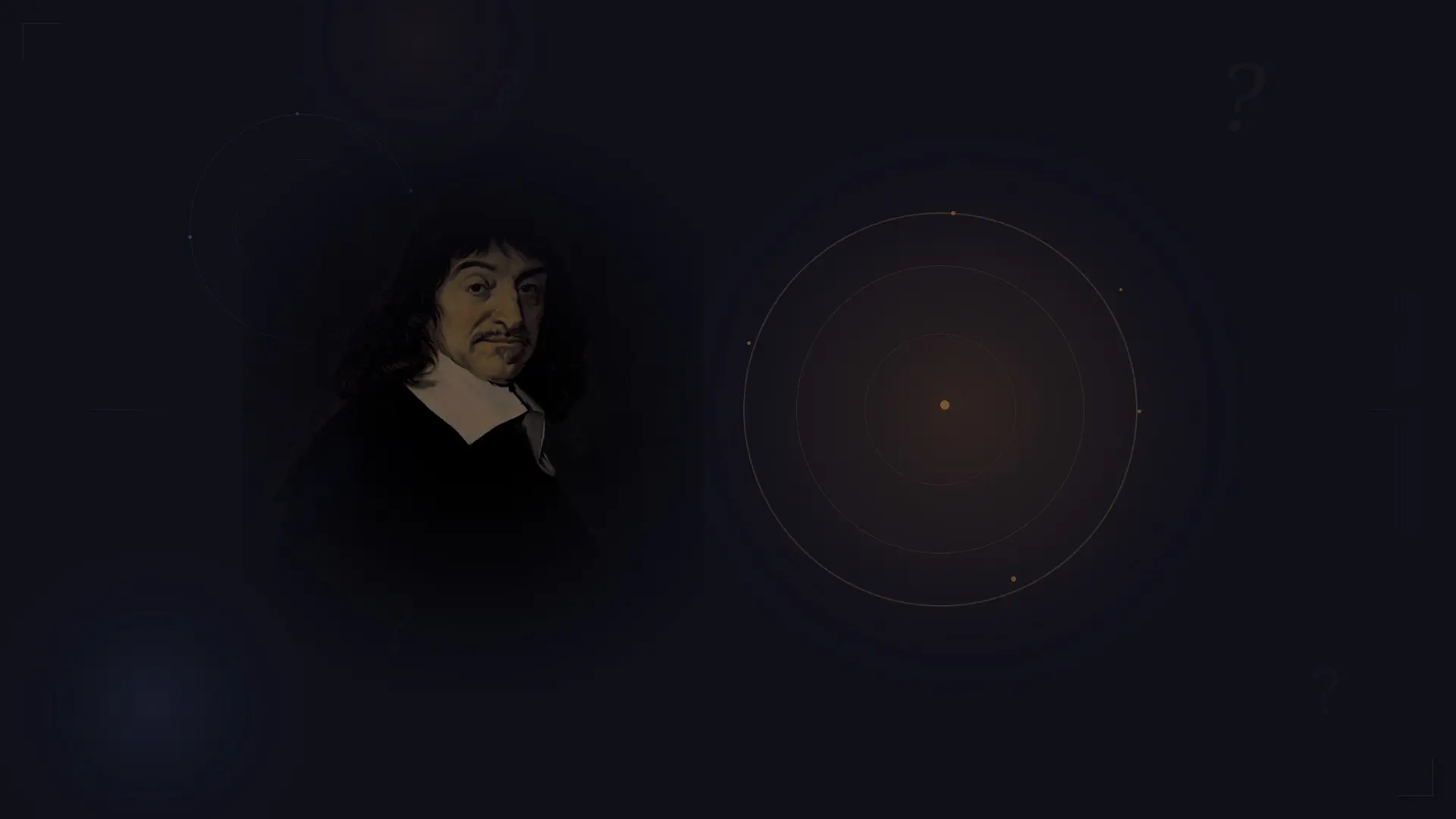
Banner image: Portrait of René Descartes, after Frans Hals (c. 1649). Public domain. Banner composition generated with AI.