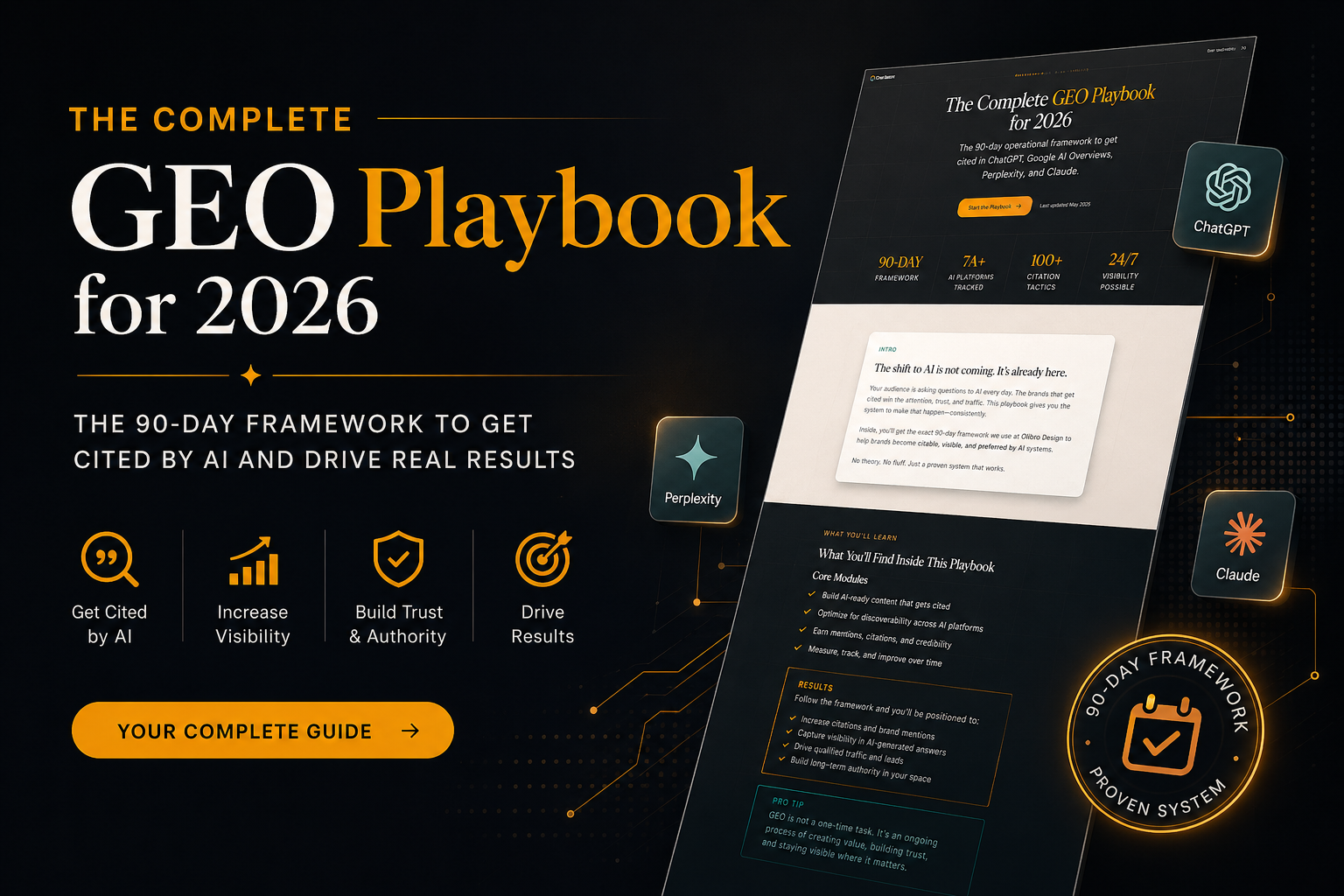
The Complete GEO Playbook for 2026
Generative Engine Optimization — what it is, what works, and the 9 tactics ranked by ROI. The two-week quickstart, the 90-day timeline, and the playbooks for ChatGPT, Perplexity, and Google AI.
By the numbers
What this playbook covers in one paragraph
Generative Engine Optimization (GEO) is the practice of structuring content so AI search engines — ChatGPT, Google AI Overviews, Perplexity, Gemini, and Claude — cite it when answering user queries. The rules for earning AI citations are fundamentally different from traditional SEO: only 6.82% of ChatGPT results overlap with Google's top 10, and 83% of AI Overview citations come from outside the organic top 10.
This is the 90-day operational framework Olibro Design uses to make client content citable by AI. It covers what GEO is and how it differs from SEO, the nine Princeton-backed tactics that lift visibility by up to 40%, the proprietary Olibro GEO Maturity Model (Levels 0–4), platform-specific tactics for ChatGPT, Perplexity, and AI Overviews, how to measure AI citation share in GA4, and the exact phased rollout we run on new engagements.
Why traditional SEO isn't enough anymore
For twenty years, search engine optimization meant one thing: rank a URL high on a list of blue links, and users will click. That contract between publishers and Google is breaking.
In 2026, when someone asks ChatGPT "what's the best web design agency in Los Angeles for healthcare clients," the response isn't a list of ten links. It's three paragraphs of synthesized advice, with four or five brands cited inline. The user makes a decision inside that answer, before any website is visited.
The numbers behind this shift are staggering. ChatGPT alone now processes roughly 2.5 billion prompts per day, a growing share of which trigger real web search and product research behavior. Perplexity handles about 50 million queries per week. Google's AI Overviews appear across 20 to 30% of searches and have caused measurable CTR collapse on positions that used to dominate organic traffic.
The silver lining, and it's a meaningful one, is that the traffic that does arrive from AI citations behaves differently. ChatGPT referrals spend an average of 15 minutes on site versus 8 minutes for Google referrals, generate 12 pageviews per visit versus 9, and convert on transactional sites at 7% versus 5% from Google, according to Similarweb's January 2026 data.
AI-referred visitors are pre-qualified, pre-informed, and pre-disposed to trust the brand — an AI just recommended them. The practical implication for any business with an organic traffic strategy: GEO is no longer optional.
What is GEO, and how does it differ from SEO and AEO?
Three acronyms, three distinct disciplines, one foundation. Toggle below to see how they actually compare in 2026.
SEO vs. GEO vs. AEO at a glance
Click any tab to see what that practice optimizes for, where it shows up, and what success looks like. GEO is highlighted as the focus of this playbook.
Traditional SEO
Optimizes for ranking in a list of blue links.
- Goal: rank #1–10 on Google SERPs
- Surface: 10 blue links, featured snippets
- Wins: keyword research, backlinks, technical SEO
- Measured by: position, impressions, clicks, CTR
- Still essential — sends 345× the traffic of all AI engines combined
GEO — Generative Engine Optimization
Optimizes for being cited inside AI-generated answers.
- Goal: get cited by name in ChatGPT, AI Overviews, Perplexity
- Surface: synthesized AI answers with inline citations
- Wins: structured content, statistics, expert quotes, schema
- Measured by: citation share, AI referral quality, brand mentions
- 83% of AI Overview citations come from outside Google's top 10
AEO — Answer Engine Optimization
Originally for voice and featured snippets — now mostly absorbed into GEO.
- Goal: be the single answer read aloud or featured
- Surface: voice assistants, featured snippets, People Also Ask
- Wins: Q&A formatting, concise direct answers, FAQ schema
- Measured by: zero-click answer share
- If you're doing GEO well, you're already doing AEO
Is GEO replacing SEO?
No. GEO is a complementary layer on top of strong traditional SEO, not a replacement. Three facts make this clear:
First, Google still sends roughly 345 times more referral traffic than ChatGPT, Gemini, and Perplexity combined as of early 2026. Second, 76.1% of Google AI Overview citations also rank in Google's top 10 — strong organic ranking remains one of the strongest signals for being cited in Google's AI answers. Third, the content structure that wins GEO (clear answers, structured data, question-based headings, citable statistics) also tends to improve traditional SEO rankings.
The brands executing well on GEO in 2026 are almost exclusively brands that already invested in foundational SEO over the previous five years. GEO is an additive layer — you don't abandon what was working; you extend it to capture the new surface area.
How generative engines actually choose what to cite
Different platforms have different architectures, but the core pipeline is remarkably consistent across ChatGPT Search, Perplexity, Google AI Overviews, Gemini, and Claude. Click each step to see what happens — and where you can intervene.
Query Interpretation
The engine parses the user's prompt, identifies intent, extracts entities, and may rewrite the query into multiple sub-questions. A query like "best WordPress agency in Santa Monica for a medical practice" gets broken into several sub-intents: entity (WordPress), location (Santa Monica), vertical (medical/healthcare), and commercial stage (hiring).
For twenty years, SEO orthodoxy has been "if you don't rank on page one, you don't exist." In 2026, pages that rank on position 20, 30, or even further down are earning AI citations because their content is structured in a way that makes them easier to extract and synthesize.
The nine Princeton-backed tactics that lift AI citation by up to 40%
The 2023 GEO paper from Princeton, Georgia Tech, and IIT Delhi tested 9 optimization tactics across thousands of queries and multiple generative engines. The top performers — Statistics Addition (+37%) and Quotation Addition (+22%) — combine for 40%+ lift. Click any tactic to see exactly how Olibro implements it.
Statistics Addition
Include specific, citable statistics every 150–200 words. Quantitative claims beat vague ones by 37%.
Olibro implementationQuotation Addition
Direct quotes from recognized experts with proper attribution. +22% citation lift.
Olibro implementationCite Sources
Inline citations to authoritative publications signal research credibility.
Olibro implementationFluency Optimization
Clear, well-structured prose. Convoluted writing reduces citation probability.
Olibro implementationUnique Words
Distinctive phrasing where appropriate. Boilerplate doesn't get cited.
Olibro implementationTechnical Terms
Industry-standard terminology with definitions on first use signals domain expertise.
Olibro implementationAuthoritative Tone
Confidence beats hedging. AI models weight claim confidence as a fluency signal.
Olibro implementationDirect Answer Format
Question-based H2s answered directly in the first 1–2 sentences. Highest-ROI tactic for existing content.
Olibro implementationStructured Data (Schema)
FAQ, Article, HowTo, and Organization schema lift AI visibility 30–40% across most verticals.
Olibro implementationKeyword stuffing, in the Princeton research, actively hurt generative engine visibility — performing worse than baseline content. The same applied to over-SEO'd content with unnaturally dense keyword patterns. Tactics that game traditional search algorithms don't game generative ones. AI models have been trained on vast amounts of natural text and can detect patterns that smell optimized.
The Olibro GEO Maturity Model
Tactics don't execute themselves. Over 18 months of GEO work across 40+ engagements, we built a five-level maturity model that describes where any business stands today. Answer the five honest questions below to find your level.
Where does your brand stand on the GEO Maturity Model?
The typical US small-to-medium business is at Level 0 or 1 as of April 2026 — a majority of brands still have zero deliberate GEO strategy. That's a first-mover opportunity that won't last. The brands currently at Level 3 started their GEO work 12 to 18 months ago. The window for catching up without a significant time penalty is narrowing every quarter.
Platform-specific playbooks
Generative engines aren't interchangeable. Each platform weights different signals, has different UI conventions, and sends different kinds of referral traffic. A brand heavily cited in Perplexity might be invisible in ChatGPT.
ChatGPT and ChatGPT Search
With 900 million weekly active users, ChatGPT is the dominant surface. Its Search feature processes 250–500 million weekly queries with real-time web retrieval. ChatGPT leans heavily on Wikipedia, Reddit, Stack Overflow, and major news outlets for factual content.
What works
- Strong Wikipedia entity presence — ChatGPT relies on Wikipedia for 71% of top domain citations
- Comprehensive long-form content (1,500+ words) with clear structure
- Brand mentions on authoritative third-party sites
- Unique statistics and original data — ChatGPT is starved for fresh, citable numbers
What doesn't work
- New websites without established authority — unknown sites get filtered
- Heavily promotional copy — editorial neutrality is favored
- Thin content under 800 words rarely surfaces
Google AI Overviews
AI Overviews appear on roughly 20–30% of Google searches as of early 2026, and on 100% of certain query types (medical, educational, how-to). 76.1% of citations also rank in Google's top 10 — traditional SEO remains the strongest foundation.
What works
- Strong existing organic rankings — top-10 positions get massive citation advantage
- FAQ schema — AI Overviews disproportionately pull from pages with structured FAQs
- Fresh content — recently updated content cited at ~3x the rate for time-sensitive queries
- Concise, extractable 40–60 word paragraphs
What doesn't work
- Stale content with no "last updated" signal
- Pages buried below position 20 with no question-formatted headings
- Walls of text without extractable answer-sized chunks
Perplexity
Smaller by volume (~50M weekly queries) but disproportionately valuable. Its 18–22% CTR on cited sources is materially higher than Google AI Overviews because citations are rendered prominently. Perplexity concentrates among researchers, analysts, journalists, and developers — high-intent professional segments.
What works
- Research-oriented, citation-dense content
- Conversational H2s that mirror natural questions
- Comparison articles — 32.5% of citations come from "X vs Y" content
- Accessible, professional-but-readable language
What doesn't work
- Marketing-speak with low information density
- Content without clear sourcing
- Overly academic prose with no plain-language anchor
Claude and Gemini
Smaller user bases but meaningful professional adoption. Claude's citation patterns favor depth and source provenance; Gemini inherits many of Google's ranking signals while adding YouTube as a heavier source than ChatGPT does. Don't build platform-specific strategies for these beyond what ChatGPT and AI Overview optimization already covers. The overlap is 70%+; diminishing returns kick in fast.
What works
- Depth-of-source content with clear provenance (Claude)
- YouTube content for verticals where video matters (Gemini)
- Whatever you're already doing for ChatGPT and AI Overviews — it transfers
What doesn't work
- Hyper-specific Claude/Gemini optimization at the expense of the big-three platforms
- Building separate content tracks for low-volume engines
The 90-day GEO engagement we run for clients
The exact phased rollout Olibro uses on new client engagements — refined across 40+ implementations in 2024 and 2025.
Audit and baseline
Before touching any content, we measure where the brand stands. The audit has four parts:
High-impact rewrites
The fastest GEO wins come from restructuring existing content rather than creating new. Zapier famously recovered declining organic traffic within 60–90 days by rewriting existing pillar posts for AI extractability — we've seen similar timelines.
New content and authority building
Net-new content specifically designed for AI citation. Every new post follows our GEO brief template — minimum 5 statistics, 3 expert quotes, question-based H2s, TL;DR, FAQ schema, and a named framework where possible.
Measurement and iteration
The first 75 days produce data. Days 76–90 are about reading that data and doubling down on what's working. By day 90, a well-executed engagement moves a client from Level 0/1 to solid Level 2 territory, with 10–15% of target queries now surfacing the brand in AI responses.
Common GEO mistakes (and what to do instead)
Most of the GEO mistakes we see with new clients aren't tactical — they're strategic. Here are the six most common, in descending order of frequency. Click any to see the fix.
We routinely see brands optimize their own content to GEO best practices but see no improvement in AI citation rates. The reason: AI engines cite what the web collectively says about a brand, not just what the brand says about itself. If nobody else on the web mentions you, no amount of on-site optimization will make AI models notice.
ChatGPT is the attention-grabbing platform, but Google AI Overviews still touch roughly 10x more total queries globally. For most businesses, optimizing for AI Overviews produces bigger absolute citation volume.
Research shows 91.4% of content cited in AI Overviews is at least partially AI-assisted — meaning AI-generated drafts aren't automatically disqualified. But AI-generated content without human editing consistently underperforms because it lacks specific statistics, first-person experience, and proprietary insights.
Brands expect GEO to produce the same kind of traffic volume as SEO and get frustrated when ChatGPT sessions are 0.2% of Google sessions. This misreads the value proposition. AI-referred visitors convert at 3–7x higher rates and represent pre-qualified prospects.
Winning AI citations for "what is SEO" has roughly the same business value as winning a Wikipedia definition — educational traffic, low commercial intent, low conversion. SEO teams keep chasing these high-volume informational queries because they feel important.
Some brands approach GEO as a discrete 2–3 month project — rewrite, add schema, declare victory, move on. AI models retrain constantly, and the competitive landscape shifts every quarter. A brand heavily cited in Q1 may be displaced by Q3 as competitors adopt similar tactics.
GEO for Los Angeles businesses
Everything above applies in any market. But LA is one of the most SEO-competitive markets in the country — 9.8 million residents across 88 cities, 55%+ speaking a non-English language at home. Layer AI search on top, and a few LA-specific plays emerge.
Neighborhood-specific entity optimization
For "web design agency in Beverly Hills" or "WordPress developer in Santa Monica," AI responses are heavily influenced by neighborhood content on Yelp, Clutch, Google Business Profile, and Chamber of Commerce directories.
Bilingual GEO for underserved markets
Only 4% of California small businesses fully localize websites in Spanish despite 39% of LA County being Hispanic or Latino. ChatGPT and Perplexity respond in the language of the prompt — this is an underexploited opportunity.
Industry-vertical authority in LA
A plastic surgery practice in Beverly Hills competes for AI citations against a different set of brands than a web agency in Culver City. Vertical-specific GEO requires understanding which publications, forums, and directories AI cites for each industry.
Your first two weeks of GEO
If you've read this far, you're convinced GEO matters. The question is what to do on Monday morning. Here's the minimal viable practice — the first two weeks you can do without hiring an agency or buying tools. Check items off as you complete them.
Week 1 Measure where you stand
Week 2 Make five changes that compound
At the end of two weeks, you won't be at Level 3 maturity, but you'll be in Level 1–2 territory and have a clear sense of what the next 60 days look like. More importantly, you'll be ahead of roughly 47% of brands that still have no deliberate GEO strategy at all.
Sources & methodology
Statistics cited in this post are drawn from these primary sources, accessed February–April 2026.
- Aggarwal, Pranjal et al. "GEO: Generative Engine Optimization." Princeton University, Georgia Tech, IIT Delhi. KDD 2024.
- Similarweb. "Generative AI Statistics for 2026" and "2026 AI Brand Visibility Index." January 2026.
- BrightEdge. "AI Overviews at the One-Year Mark" (February 2026) and "AI Brand Risk for CMOs" (March 2026).
- ConvertMate. "GEO Benchmark Study 2026," analyzing 12,500+ queries across 8,000 domains. March 2026.
- OpenAI. Weekly active user disclosures, February 2026. DemandSage ChatGPT statistics report.
- Conductor. "2026 AEO/GEO Benchmarks Report," analyzing 13,770 domains and 17 million AI responses.
- Google Search Central, Anthropic, and OpenAI platform documentation. 2024–2026.
- Olibro Design internal data: 40+ client GEO engagements run from mid-2024 through April 2026. Client data is aggregated and de-identified for publication.



Have a project in mind?
We help businesses ship websites that work — on WordPress, Shopify, and AI-ready infrastructure.